🔹 304 / 304L
The all-rounder. FeCl₃ at 40 °C. Horizontal precision for shims & meshes.
Photochemical etching for 304, 316L, 430, 17-4 PH and other stainless grades. Ferric chloride (FeCl₃) etchant with built-in regeneration — burr-free, ±0.02 mm, 0.02–1.5 mm thickness. From nameplates and badges to filter meshes and shims. Exported since 2003.
Stainless steel is the most common metal run through GE photochemical etching machines. 304 for nameplates, kitchen panels and architectural decor; 316L for medical, marine and PEMFC bipolar plates; 17-4 PH for aerospace gaskets and high-stress automotive. The chemistry is consistent — FeCl₃ works across the family — but the line tuning changes by grade.
Each grade has a recommended combination of machine + chemistry.
The all-rounder. FeCl₃ at 40 °C. Horizontal precision for shims & meshes.
Mo-bearing, more corrosion-resistant. Same FeCl₃, slightly higher Baumé for medical & marine. Horizontal precision
Hardened, used in aerospace & oil & gas. We add 2% HCl activator. Heavy-duty line
Magnetic, lower cost. Mild FeCl₃ + inhibitor bath. Nameplate machine
Dilute FeCl₃ to control undercut. Precision vertical
Mesh, sensor grid, acoustic webs. Super thin-plate

Workhorse for nameplates, panels, sign blanks.

Where geometries demand the tightest tolerances.

Built for ultra-thin foil that ordinary lines would tear.
Three GE machines cover the bulk of stainless work. Each below has its own spec sheet, etchant recommendation and control philosophy.

The workhorse. Two etch chambers for uniform etch on 304/316L/17-4/430.
| Power | 11.5 kW / 380 V / 50 Hz |
| Etching width | 650 / 1000 / 1220 / 1550 mm (order) |
| Thickness | 0.05–2.0 mm |
| Tolerance | ±0.02 mm |
| Temp range | RT – 65 °C |
| Heater | 3 kW titanium pipe |
| Tank volume | 800 L |
| Spray | Double-side oscillating nozzles, 4 kW ×2 motors |
| Cabinet | PP, high-temp resist up to 100 °C |
| Dimension | 3550 × 1650 × 1550 mm |
| Weight | 850 kg |
Process flow: Load → Etch ×2 chambers → city-water rinse → Unload.
For plate up to 1550 mm & long production campaigns. Heavier motors, larger tank.
| Power | 15 kW / 380 V / 50 Hz |
| Etching width | 650 / 1000 / 1220 / 1550 mm (order) |
| Thickness | 0.05–2.0 mm |
| Tolerance | ±0.02 mm |
| Tank volume | 800 L |
| Spray | Double-side oscillating, 4 kW ×2 |
| Cabinet | PP, ≤100 °C |
| Dimension | 3850 × 1650 × 1550 mm |
Same tank as JM650, larger drive system. Best when running 24×7.
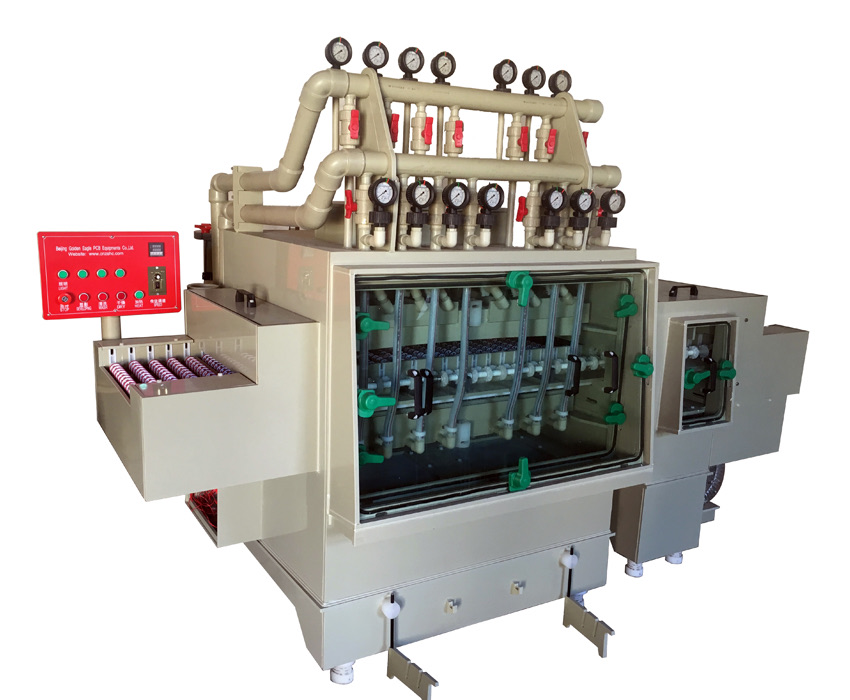
Bench-to-floor vertical machine for fine meshes, encoder discs & SMT stencils.
| Power | 5.5 kW / 380 V / 50 Hz |
| Etching size | 650 × 650 mm (custom) |
| Thickness | 0.05–5.0 mm |
| Tolerance | ±0.02 mm |
| Spray | Top & bottom oscillating, 4 kW |
| Tank volume | 400 L |
| Cabinet | PP, ≤100 °C |
| Dimension | 1850 × 1650 × 1550 mm |
| Weight | 450 kg |
Vertical architecture halves the floor footprint. Common in lab/medical.
The GE-JM650 stainless etching line is GE's most-shipped model — 1,400+ units in the field since 2008. The dual-chamber design was a deliberate answer to the “edge-thicker-than-middle” problem that single-chamber lines showed on 1.0 mm plate. By splitting the etch into two zones, the first chamber takes the bulk chemistry and the second does the polishing pass; land-width distribution stays under ±15 μm panel-to-panel, well inside the ±0.02 mm envelope.
The GE-JM650-W is the wide variant — up to 1550 mm chamber width, with 15 kW of drive (vs 11.5 kW on the standard JM650). For sign blanks, decorative stainless panels and any 1220 mm-wide substrate, the -W removes the bottleneck of feeding multiple blanks side-by-side.
The GE-TS650 vertical precision machine is the choice when the part is smaller than 650 × 650 mm. The vertical architecture means the etchant sprays down from above and up from below simultaneously, so even an asymmetric part (a half-etch on one side, full etch on the other) settles into the correct chemistry without re-fixturing.
All three machines accept ferric chloride (FeCl₃) or, with a chemistry swap, alkaline solution. They share the same HMI control platform, so operators trained on one work the other two with no extra ramp-up.
Three parameters control the etch: concentration, temperature, agitation.
38–42 Bé (≈ 38% wt FeCl₃). Lower for foil, higher for plate.
38–45 °C. Too high dissolves the resist; too low slugs the etch rate.
Oscillating spray nozzles, 1.5–2.5 m/s. Critical for uniform undercut.
H₂O₂ + HCl re-oxidises spent Fe²⁺ back to Fe³⁺. Standard on EU/US lines.
HCl boost for 17-4 PH and 430. Ammonium persulphate for fine-grain austenitic.
Neutralise to pH 8–9, settle Fe(OH)₃ sludge, treat rinse water for Cu/Zn.
Six things to read next — same chemistry, similar tolerances, or the next step in your process.
CuCl₂ chemistry, electrolytic Cu recovery →
NaOH alkaline etch, Al(OH)₃ recovery →
Ti / Ti-6Al-4V, PFA-lined HF chemistry →
304 / 316L gaskets & shims →
316L scalpels & stents →
Stainless conveyorised etch + strip + dry →
Tell us your grade (304 / 316L / 17-4 / 430), sheet thickness and annual volume. We'll spec the machine, the FeCl₃ loop and the regeneration package.